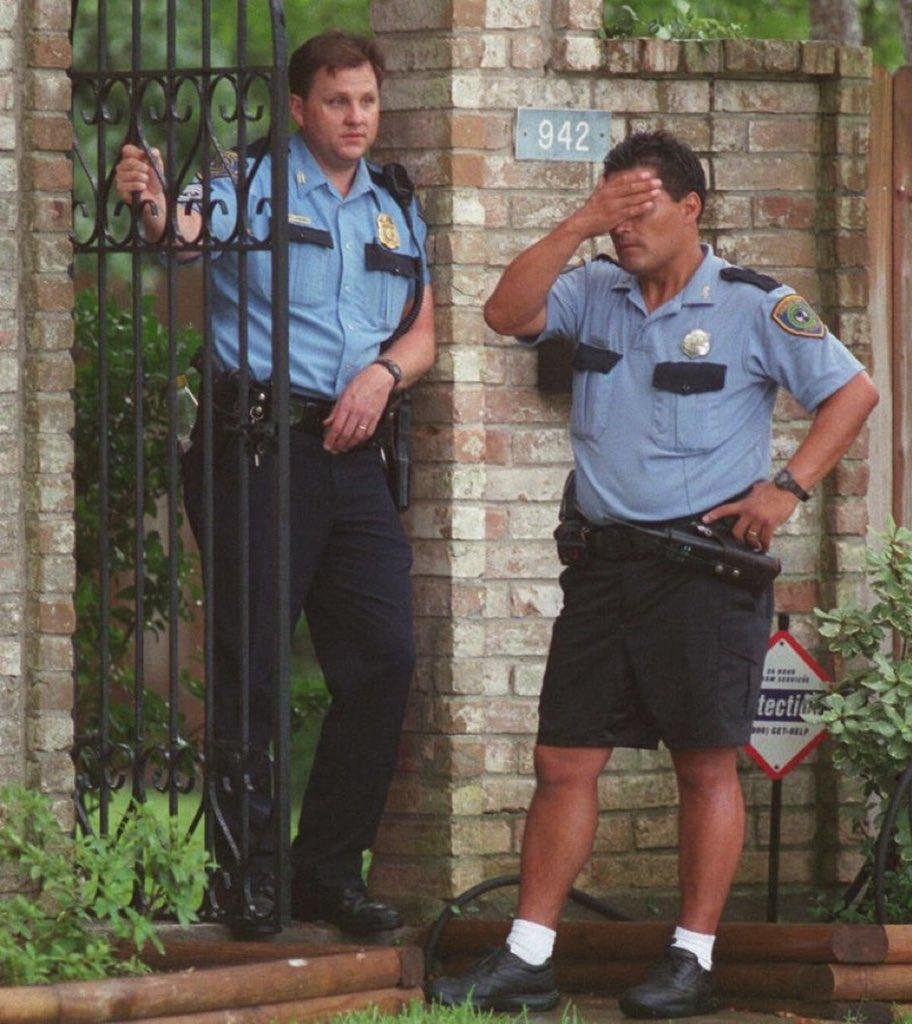
Houston police officers stand outside the house in Clear Lake City, where Andrea Yates drowned her 5 children.
In June 2001, Andrea Yates drowned her five children in their bathtub.
Yates started with John, Paul, and Luke, and then laid them in her bed. She then drowned Mary, whom she left floating in the tub. Noah came in and asked what was wrong with Mary.
He then ran, but Yates soon caught and drowned him. She left him floating in the tub, and laid Mary in John's arms in the bed.
She then called the police, repeatedly saying she needed an officer but refusing to say why.
In 2002, Yates was convicted of capital murder, but the jury refused the death penalty option. She was sentenced to life in prison with the possibility of parole after forty years.
The verdict was overturned on appeal, in light of false testimony by one of the supposed expert psychiatric witnesses.
On July 26, 2006, a Texas jury in her retrial found that Yates was not guilty by reason of insanity because she exhibited severe postpartum depression, postpartum psychosis, and schizophrenia leading up to the murders.
She was consequently committed by the court to the high-security North Texas State Hospital in Vernon, where she received medical treatment.
Houston police officers stand outside the house in Clear Lake City, where Andrea Yates drowned her 5 children.
In June 2001, Andrea Yates drowned her five children in their bathtub.
Yates started with John, Paul, and Luke, and then laid them in her bed. She then drowned Mary, whom she left floating in the tub. Noah came in and asked what was wrong with Mary.
He then ran, but Yates soon caught and drowned him. She left him floating in the tub, and laid Mary in John's arms in the bed.
She then called the police, repeatedly saying she needed an officer but refusing to say why.
In 2002, Yates was convicted of capital murder, but the jury refused the death penalty option. She was sentenced to life in prison with the possibility of parole after forty years.
The verdict was overturned on appeal, in light of false testimony by one of the supposed expert psychiatric witnesses.
On July 26, 2006, a Texas jury in her retrial found that Yates was not guilty by reason of insanity because she exhibited severe postpartum depression, postpartum psychosis, and schizophrenia leading up to the murders.
She was consequently committed by the court to the high-security North Texas State Hospital in Vernon, where she received medical treatment.












 Arabic
 French
 Spanish
 Portuguese
 Deutsch
 Turkish
 Dutch
Dutch
 Italiano
 Russian
 Romaian
 Portuguese (Brazil)
 Greek
Greek